Submarine cables carry the majority of intercontinental data traffic and are increasingly becoming the backbone of offshore wind farm power transmission. Unlike land-based cables, they operate in one of the most harsh environments on Earth - continuous exposure to seawater, immense hydrostatic pressure, and mechanical stress from laying and recycling operations. An insulation defect in a high-voltage submarine cable can cause a power outage that costs millions of dollars and takes several months to repair. Therefore, choosing appropriate testing equipment is not a procurement form, but a risk management decision.
Priority given to voltage level and cable type
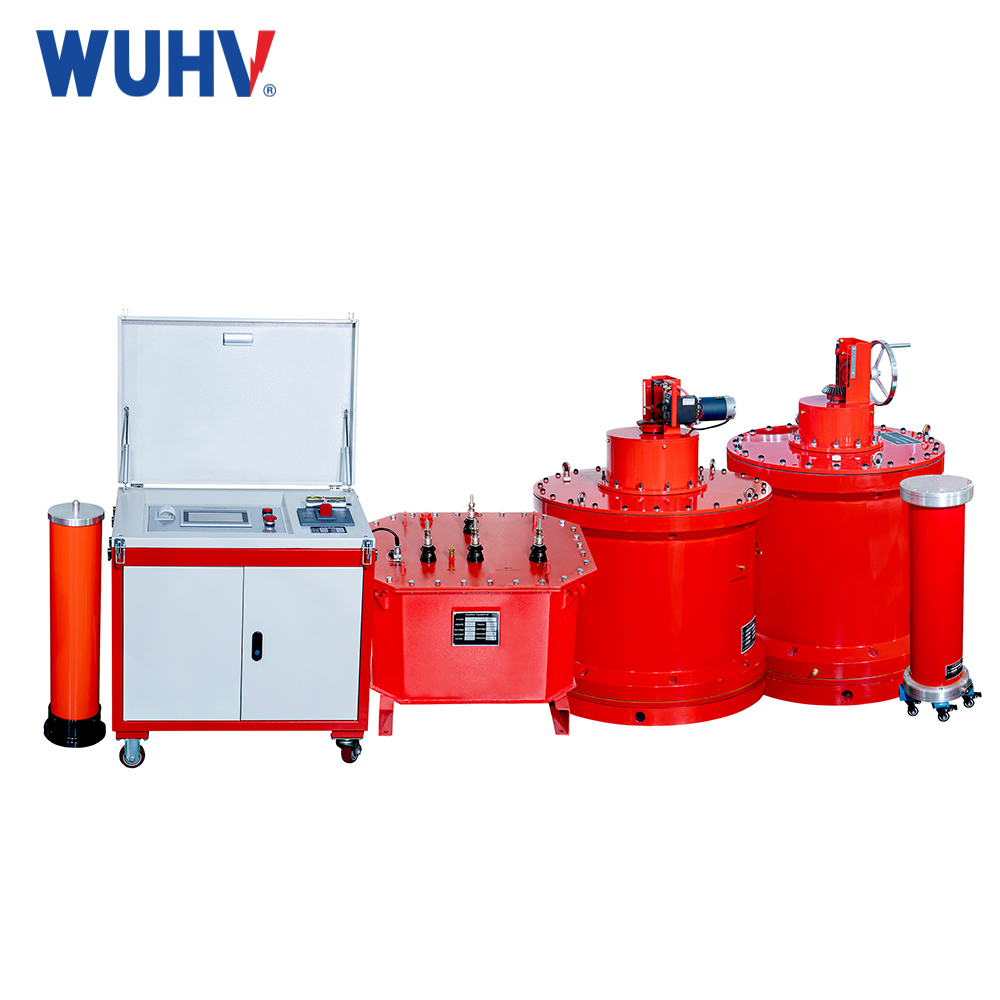
The most important single selection parameter is the rated voltage of the tested cable. 10kV distribution submarine cables and 220kV transmission submarine cables require completely different test configurations. For AC submarine cables with a rated voltage not exceeding 35kV, a variable frequency series resonance test system with an output frequency in the range of 30-300Hz and a voltage capacity of 22kV to 52kV is usually sufficient. For higher voltage applications -110kV and above - equipment must be stepped up to 128kV or higher, which in practice means larger reactors, more parallel units, and higher capacity excitation transformers.
The length and capacitance of the cable also determine the selection. Longer cables have higher capacitance, requiring the testing system to resonate at lower frequencies while maintaining stable voltage output. If the cable exceeds 10km, multiple reactors may need to be connected in parallel to achieve the necessary tuning range. For submarine cables that often span tens of kilometers, this is not an edge condition - it is the norm.
Test voltage, frequency, and duration
The standards such as IEC 60502-2 and IEEE 400.2 stipulate that the test voltage is a multiple of the rated voltage (U ₀) of the cable, the frequency range, and the duration. For 35kV cables, the standard requires 2U ₀ - approximately 70kV - to be applied for 60 minutes. The equipment must be able to maintain this voltage with minimal fluctuations. A waveform distortion below 1.0% is usually acceptable to obtain accurate results.
Frequency tuning accuracy is more important than many buyers realize. If the resonant frequency drifts slightly, the voltage at both ends of the cable will become unstable. Modern digital signal processing (DSP) systems can lock the resonance point within 10 milliseconds, which is a significant improvement over manual tuning and reduces the risk of overvoltage during the search phase.
Site conditions and deployment form
Submarine cable testing is rarely conducted in temperature controlled laboratories. The experiment is conducted at the landing station, cable laying ship, or offshore substation. The equipment must withstand humidity, salt spray, and temperature fluctuations. For extensive outdoor use, dust-proof and moisture-proof enclosures are worth the additional cost. For offshore wind power applications, some operators prefer containerized testing systems that can be installed on ship decks or permanently installed in wind farm substations.
Portability is another factor. A well functioning test equipment in a fixed substation may not be practical on cable laying ships with limited space and expensive crew time. Rack mounted or reinforced portable designs are often more valuable in practice than higher specification desktop devices that cannot be transported.
Integration with fault location and partial discharge detection
The submarine cable testing system does not operate in isolation. After the withstand voltage test, if defects are suspected, it is best for the same test configuration to support partial discharge (PD) localization. In a recorded case, a variable frequency series resonant system applied to a 500kV submarine cable detected a local discharge source 873 meters away from the terminal; Excavation confirmed mechanical damage to the insulation layer, and early detection avoided an estimated potential loss of 200 million yuan.
This result not only requires a withstand voltage test. The equipment should be compatible with partial discharge detectors and, where possible, include meter level precision fault location algorithms. Cloud based reporting and remote operation capabilities also increase practical value, especially for operators managing multiple login sites across different time zones.
Beyond Electrical Testing: Mechanical and Environmental Validation
Not all submarine cable tests are electrical tests. Mechanical properties - tensile strength, bending radius under tension, and fatigue resistance - are equally critical, especially for cables that will be laid at depths exceeding 1000 meters or in high current areas. A tension bending test device with a load capacity of up to 1000kN and displacement measurement accuracy within ± 0.5%, used to simulate laying and recovery conditions before cable deployment. These are different categories of equipment from electrical testing equipment, but for any operator debugging a new submarine cable system, they belong to the same procurement discussion.
For buyers who choose in this field, the actual order is to determine the highest voltage level to be tested, calculate the capacitance range of the longest cable, confirm the standard driving test voltage and duration, and then match these requirements with a system with sufficient tuning range and stability. Wuhan UHV Power Technology has over 20 years of experience in the field of high-voltage testing equipment, providing variable frequency series resonant systems for submarine cable withstand voltage testing.