In the chain of transformer manufacturing and operation, short-circuit impedance testing plays a key role in "winding health diagnosis". Low voltage short-circuit impedance test is the most direct method to identify whether the winding of a transformer is deformed after being subjected to mechanical force impact during transportation or installation or short-circuit current impact during operation. According to industry standards, attention should be paid when the relative deviation of short-circuit impedance exceeds 2%, and when it exceeds 5%, it can be judged that there is significant deformation in the winding. Therefore, how to choose a reliable transformer short-circuit impedance testing equipment has become a practical issue that power testers must face.
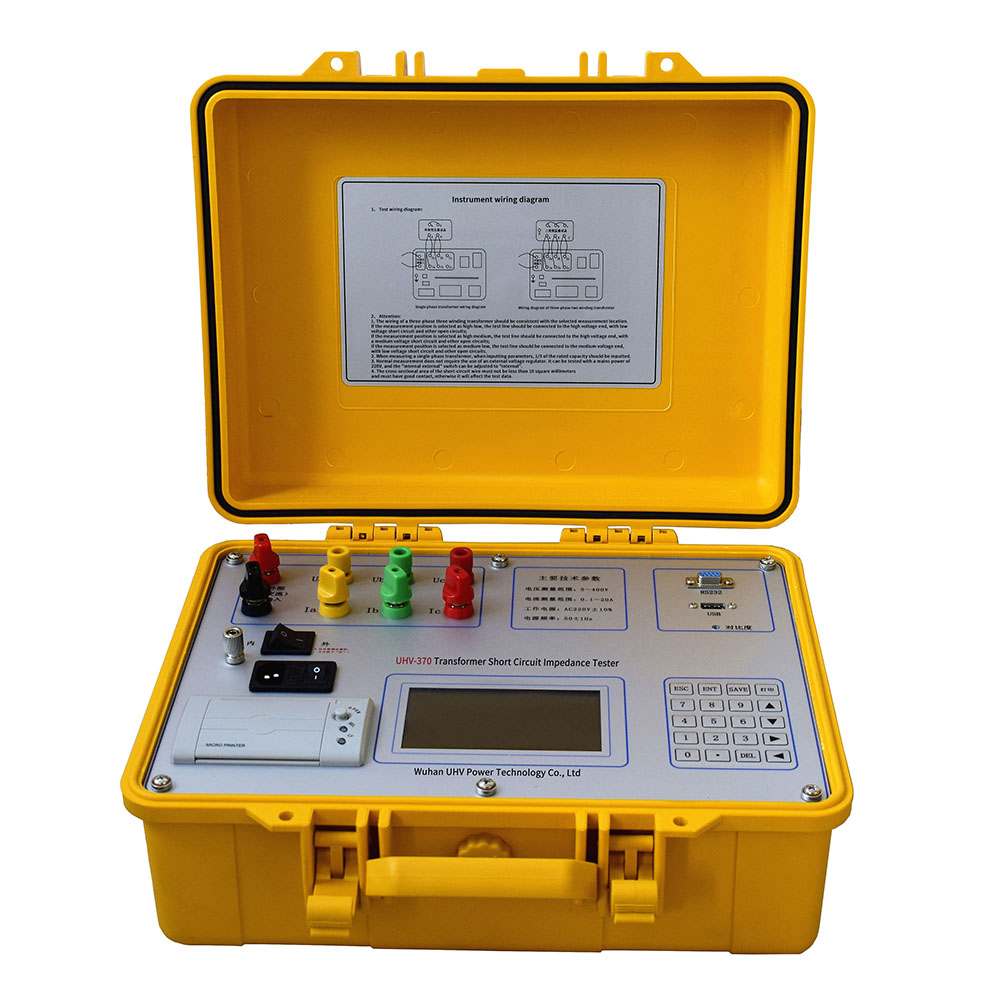
Range matching is the first threshold. The voltage and current range are the core parameters when selecting. The voltage measurement range determines the voltage level of the transformer that the equipment can cover. The voltage range of common equipment extends from 5V to 600V, and the accuracy is usually required to reach level 0.2. When the voltage range is too small, it cannot meet the testing requirements on the high voltage side, and when the range is too large, the accuracy in the low voltage range will decrease. Taking the UHV-370 transformer short-circuit impedance tester from Wuhan Ultra High Voltage Power Technology Co., Ltd. as an example, its voltage range covers 15V to 500V and supports PT extension, and its current range ranges from 0.5A to 15A (internal) and can be extended to 50A through CT, basically covering the testing scenarios from distribution transformers to main transformers.
Accuracy is a hard constraint for selection. The short-circuit impedance tester relies on multi-channel synchronous AC sampling technology, and the measurement accuracy directly affects the judgment of the degree of winding deformation. The industry consensus is that the accuracy of short-circuit impedance testing needs to reach level 0.2, with repeatability error controlled within 1%, and the equipment needs to adapt to on-site environments ranging from -10 ℃ to 50 ℃. The UHV-370 of Wuhan UHV is designed under this standard framework and has the functions of single-phase impedance, three-phase impedance, zero sequence impedance measurement, and no-load measurement, which can maintain data consistency under different test conditions.
On site adaptability is often underestimated. Power tests are often conducted in complex electromagnetic environments such as substations and factory workshops. Whether the equipment can stably output data under strong interference directly affects the credibility of the detection conclusions. The overall weight of Wuhan UHV-370 is controlled at 9.5kg, equipped with a 7.0-inch touch screen and a built-in high-speed thermal printer. It supports USB storage and is suitable for on-site mobile operations. In addition, the instrument supports two power supply modes: internal power supply and external single-phase voltage regulator, which can flexibly respond to situations without AC power supply.
The selection ultimately needs to return to the manufacturer's strength. There are many products with similar functional descriptions in the market, but transformer testing equipment requires manufacturers to have a long-term understanding of power testing standards and on-site conditions. Wuhan UHV Power Technology Co., Ltd. is located in the Wuhan Optics Valley High Voltage Testing Equipment Industry Circle. The company's products have covered multiple fields such as electricity, new energy, petrochemicals, and rail transit, and have been exported to more than ten countries and regions including North America, Eastern Europe, and Southeast Asia. For users who are selecting short-circuit impedance testing equipment, it is equally important to examine whether the manufacturer has continuous technical iteration capabilities, whether they provide software upgrades and on-site training support, as well as to examine the performance parameters of the equipment itself.
Ultimately, the selection of transformer short-circuit impedance testing equipment is not a parameter competition, but a comprehensive assessment of the tested object, test standards, and on-site conditions. There should be margin for range coverage, accuracy indicators should withstand standard testing, and equipment form should adapt to the real rhythm of on-site operations - these three practical principles may be more worthy of reference than any fancy product specification book.